Key takeaways
The Monash Institute of Transport Studies found the Gold Coast is operating 14% above its ideal capacity, making it the nation’s most overpopulated city.
Other overstretched areas include the NSW Central Coast (13%) and Murray Bridge in South Australia (12%)
Researchers defined a city’s ideal size based on capital city status, job access, service mix, and connectivity.
Cities within 4% of their “just right” size save renters an average of $1,560 per year, reduce car dependence, and allow more people to walk to work.
Rents are among the least affordable in Queensland, with almost no options for low-income earners or those on income support.
Despite stress, demand remains strong due to lifestyle appeal, hybrid work, migration, and upcoming Olympic investment.
Prices are likely to continue rising, but affordability challenges and infrastructure strain present risks that investors must factor in.
Investors will find better long-term opportunities in Brisbane.
What happens when your dream holiday destination turns into a staging ground for gridlock, sky-high rents, and near-invisible housing options?
Welcome to the Gold Coast—a city fighting to catch up with its own popularity.
It was once known for its glittering beaches, holiday resorts, and laid-back lifestyle, but today, the Gold Coast has earned a very different title: Australia’s most overpopulated city.
According to new research from the Monash Institute of Transport Studies, the Gold Coast has grown well beyond its “ideal” size.
The study measured 655 Australian cities and found that the Coast is currently sitting at around 14% above its sustainable capacity.
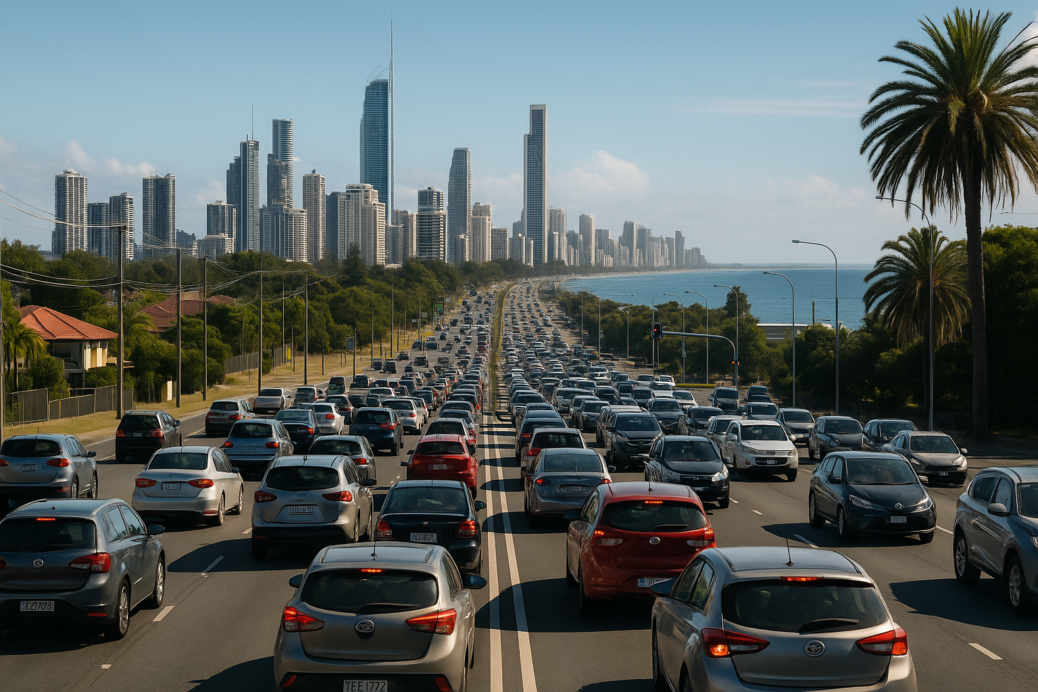
In practical terms, that means clogged highways, longer commutes, skyrocketing rents, and a housing market that’s almost outpacing Sydney.
What was once Australia’s playground has now become a city under strain.
What makes a city “too big”?
The researchers weren’t just counting heads.
They looked at four factors that make cities tick:
-
Whether it’s a capital city,
-
Access to jobs,
-
The mix of services available,
-
And how well-connected the city is.
They found that when a city grows too big, the warning signs are obvious: traffic jams, overcrowded services, and housing that becomes unaffordable for the very people who keep the city running.
But interestingly, cities that were closer to their “just right” size delivered tangible benefits.
Renters saved an average of $1,560 a year, more people could walk to work, and hundreds of thousands of households needed fewer cars.
So, it’s not about size alone; it’s about balance.
Growth outrunning infrastructure
On the Gold Coast, demand has simply run ahead of supply.
Population growth, fuelled by lifestyle demand and interstate migration, has outpaced the infrastructure meant to support it.
Property prices tell the story clearly.
The median house price on the Gold Coast has surged to $1.32 million; the only regional market in Australia where prices outstrip its capital city.
Over the past year, prices have jumped nearly 9%, more than double the pace of Sydney.
And it’s not just buyers feeling the squeeze. Renters are under severe stress too.
A recent report revealed “close to zero affordable options” for low-income earners, with conditions deteriorating further over the past 12 months.

Note: The Gold Coast is now the least affordable rental market in Queensland.
Why this matters beyond the Gold Coast
You might be thinking: “Well, that’s the Gold Coast, what about the rest of the country?”
But the truth is, this isn’t just a local problem.
Other areas like the NSW Central Coast, Murray Bridge, Sydney, Melbourne, and even the Sunshine Coast are all over capacity according to the report. .
Meanwhile, Perth and Port Pirie are closer to their “ideal size.”
This tells us something important about urban growth: Australia’s population distribution is increasingly lopsided.
Some cities are bursting at the seams, while others aren’t reaching their potential.
What needs to change?
Associate Professor Liton Kamruzzaman, who led the study, suggests practical solutions:
-
Smarter transport links to reduce congestion,
-
Better balance of jobs across regions (not just clustered in one CBD),
-
Fairer land-use rules that encourage sustainable development.
In other words, we need policies that don’t just encourage growth but also manage it.
If we get it right, we can build cities that are big enough to thrive, but not so big that they collapse under their own weight.
What it means for property investors
For property investors, the Gold Coast remains a market underpinned by strong demand and limited supply; a combination that usually pushes prices higher.
With the Olympics on the horizon, infrastructure investment underway, and interstate migration still flowing, it’s hard to see demand easing anytime soon.
But affordability pressures, rental stress, and liveability challenges are flashing red lights.
Investors are likely to find better investment options in Brisbane where significant growth potential remains, without the same structural pressures.
But, as always, will need to be selective, focusing on locations that benefit most from infrastructure upgrades and lifestyle demand.
If you’re like many property investors, you’re probably wondering what’s the right thing to do at present.
Should you buy, should you sell, or should you just wait?
You can trust the team at Metropole to provide you with direction, guidance, and results.
Whether you’re a beginner or an experienced investor, at times like we are currently experiencing you need an advisor who takes a holistic approach to your wealth creation and that’s exactly what you get from the multi-award-winning team at Metropole.
We help our clients grow, protect and pass on their wealth through a range of services including:
- Strategic property advice – Allow us to build a Strategic Property Plan for you and your family. Planning is bringing the future into the present so you can do something about it now! Click here to learn more
- Buyer’s agency – As Australia’s most trusted buyers’ agents we’ve been involved in over $4Billion worth of transactions creating wealth for our clients and we can do the same for you. Our on the ground teams in Melbourne, Sydney, and Brisbane bring you years of experience and perspective – that’s something money just can’t buy. We’ll help you find your next home or an investment-grade property. Click here to learn how we can help you.
- Property Development – We enable you to become an “armchair developer” and get all the benefits of property development without getting your hands dirty. We take the hassles out of your investment by assisting you with all the expertise you need, from concept to completion, including construction. Click here to see if it’s the right way for you to grow your portfolio.
- Wealth Advisory – We can provide you with strategic tailored financial planning and wealth advice. Click here to learn more about we can help you.
- Property Management – Our stress-free property management services help you maximise your property returns. Click here to find out why our clients enjoy a vacancy rate considerably below the market average, our tenants stay an average of 3 years, and our properties lease 10 days faster than the market average.